Atlas Energy: We Build Hard Things
How Atlas Energy Solutions’ billion-dollar construction record is powering its next chapter
Executive Summary: In the energy industry, ambition matters. Execution matters more.

Large infrastructure projects test far more than a company’s ability to finance equipment or manage contractors. They require engineering judgment, procurement discipline, field leadership, electrical expertise, controls integration, commissioning and an operating organization capable of supporting the asset long after construction ends.
Atlas Energy Solutions has developed those capabilities by building some of the most ambitious industrial infrastructure in the Permian Basin.
Atlas has invested more than $1 billion in infrastructure, including large-scale mining facilities, processing and storage systems, and the 42-mile Dune Express conveyor. President and CEO John Turner has described the company’s record in direct terms: Atlas has put “over a billion dollars of infrastructure in the ground” and built an organization that can design, engineer, construct and operate its own assets.
Two projects demonstrate that capability particularly well: the development of Atlas’ Kermit mining complex and the construction of the Dune Express. Together, they show what Atlas means when it says it can build hard things.
Building Industrial Scale at Kermit
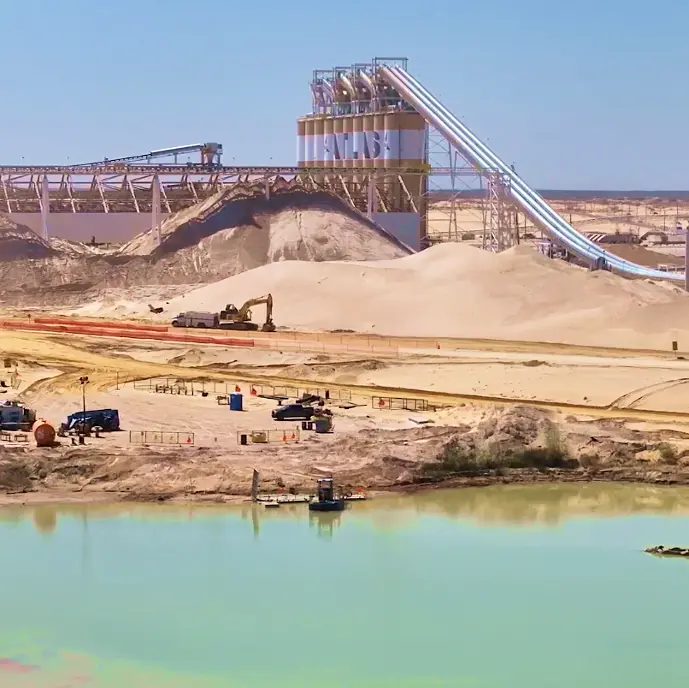
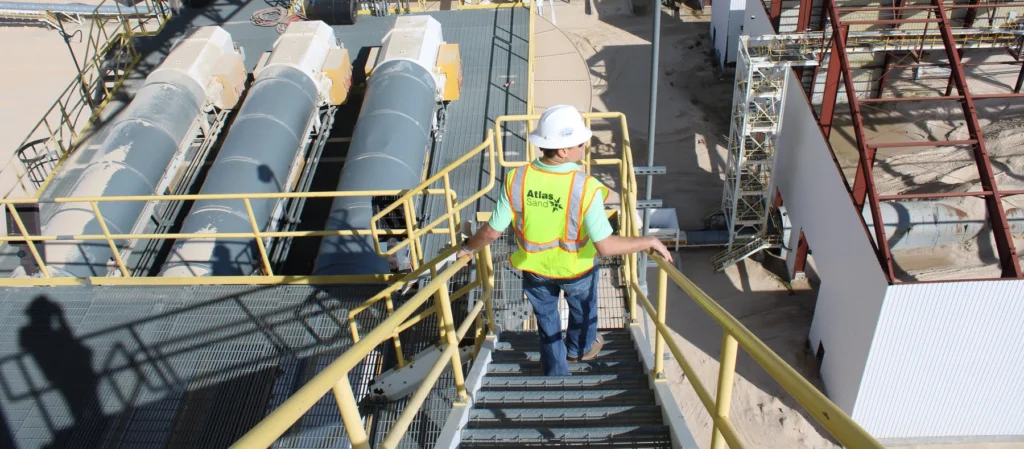
The Kermit facilities form the operational center of Atlas’ sand production and logistics network in West Texas. This is not simply a mine with processing equipment attached. It is an integrated industrial complex developed to produce, process, store and load proppant at the scale and reliability required by modern oil and gas completions.
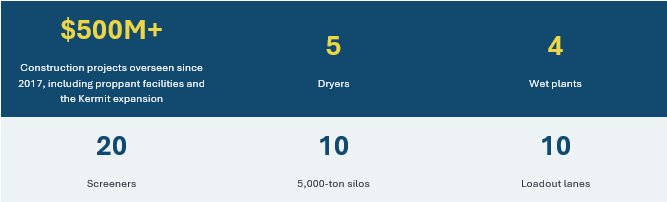
Atlas materials identify more than $500 million of construction projects overseen by the company since 2017, including proppant facilities and the Kermit expansion. The Kermit operation combines wet processing, drying, storage, screening, electric dredging, automated check-in and high-capacity truck loadout infrastructure.
The electrical element is important. Electric dredging reduces the need for diesel-powered mobile equipment in the mining pit, lowering fuel use, maintenance demands and equipment interactions while supporting a more efficient operating model.
Atlas has acted as its own general contractor on major construction activity. That approach gives the company direct visibility into engineering, procurement, construction expenditures, schedule and commissioning. Rather than handing over the outcome entirely to an outside party, Atlas developed the internal oversight required to manage the full project lifecycle.
Kermit therefore represents more than production capacity. It is evidence that Atlas can assemble multiple engineering disciplines into one functioning industrial system, bring that system into operation and continuously improve it. That experience became the foundation for a much more ambitious project.
The Dune Express: Electrifying a 42-Mile Industrial System
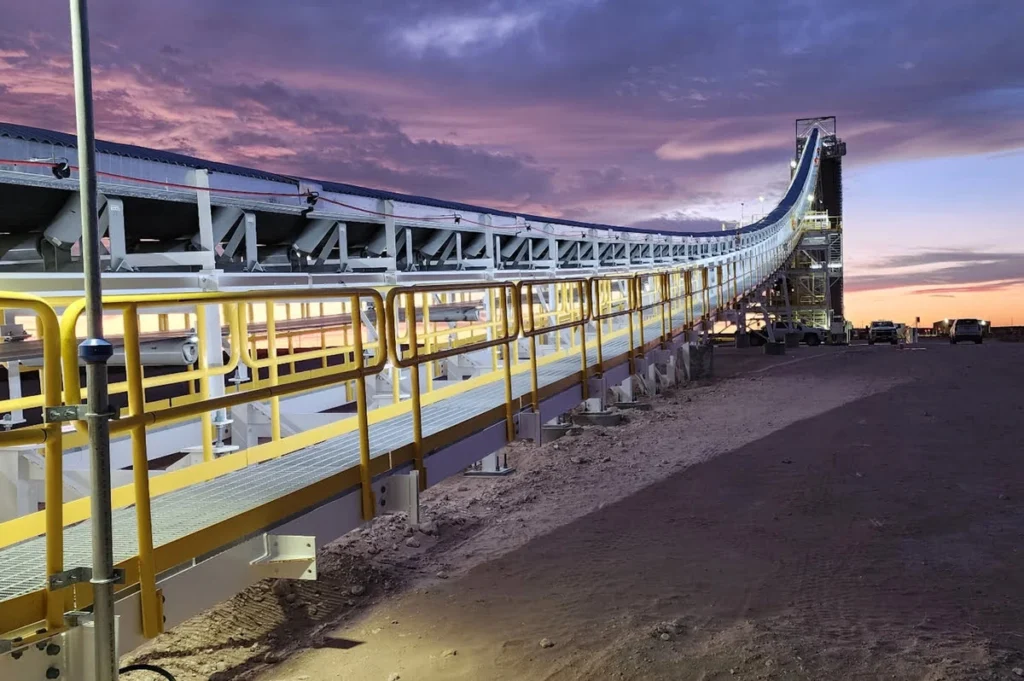
The Dune Express is a fully electrified, 42-mile overland conveyor connecting Atlas’ Kermit operations with the Northern Delaware Basin. Designed to transport up to 13 million tons of proppant annually, the system is tied to approximately 85,000 tons of storage, two permanent loadout facilities and a mobile offload system.
Its purpose is straightforward: move enormous volumes of sand closer to the wellsite while reducing the portion of the journey completed by truck. Its engineering is anything but simple.

The system contains more than 452,000 feet of belting and 68,796 individual idler rollers. Its combined conveyor drives provide approximately 15,800 horsepower. The longest individual belt section extends 16.4 miles and is driven by six 900-horsepower motors, providing 5,400 horsepower on that section alone. Across the route, the conveyor manages an elevation change of approximately 320 feet.

Managing Power Across the Desert
Supplying electricity to a system of this scale in a remote operating environment required Atlas to address power as a core part of the project rather than as a supporting utility.
Atlas owns and operates two substations with a combined capacity of 90 megawatts and owns and maintains more than 100 megawatts of power infrastructure supporting its plants, mines and related operations.
The Dune Express electrical architecture distributes power across multiple stations along the route. Internal planning materials identify station loads at the Kermit silos, successive conveyor transfer stations, the Stateline area, the end-of-line facility and the end-of-line silos. The system accommodates equipment at multiple utilization voltages, including 120-volt auxiliary loads, 480-volt equipment and 4,160-volt motor loads.
The electrical challenge is not simply delivering a large block of power to one building. Power must be delivered, transformed, distributed, protected and controlled across a linear facility stretching 42 miles through remote terrain.
Every transfer point and conveyor section must function as part of the larger system. Motors, gearboxes, lubrication systems, sensors, safety interlocks, silos and loadout equipment must work in sequence. A failure at one point can interrupt material flow across the line, making electrical protection, controls integration, equipment monitoring and maintainability central to overall availability.
The mechanical drive systems reflect these demands. The Dune Express uses 36 custom heavy-industry gear units engineered for high torque and application-specific thermal requirements. The equipment program included gearbox sizing, thermal performance modeling, bearing-life analysis, mechanical interface verification, condition-monitoring sensors, safety-guarding specifications, delivery coordination and commissioning support.
These requirements were intensified by extended duty cycles, desert heat and rugged terrain. The project therefore required more than sufficient horsepower. It demanded thermal validation, torque capacity, electro-mechanical integration and a maintenance strategy suitable for a remote industrial asset.
The result is a system that converts electricity into continuous material movement at industrial scale. Instead of assigning the primary 42-mile journey to diesel trucks, Atlas uses stationary electric motors to move sand to strategically located storage and loadout infrastructure for the remaining trip to customers.

More Than a Construction Milestone
The Dune Express required Atlas to coordinate rights-of-way, design, engineering, equipment procurement, civil construction, substations, electrical distribution, motors, drives, controls, storage, loadout infrastructure, commissioning and long-term operations.
The first commercial delivery traveled from Atlas’ Kermit facility to its end-of-line operation on January 12, 2025. That event marked the transition of the Dune Express from a major construction program into an operating logistics asset.
Its greater significance may be what the project reveals about Atlas. The solution required mining knowledge, bulk-material handling, civil construction, electrical infrastructure, automation, logistics and operations. Atlas did not treat those as separate projects. It integrated them into one system built around the customer’s need for reliable delivery.
That is the same execution mindset required for large power projects.
From Moving Sand to Delivering Power
Atlas’ expansion into behind-the-meter power is not a departure from its history. It is an application of capabilities the company has already developed.
Large power facilities require disciplined project development, electrical engineering, equipment procurement, civil construction, controls integration, commissioning, operations and lifecycle maintenance. They also require practical experience with remote power delivery, distributed electrical loads, critical-equipment protection, total delivered-power costs and system-level reliability.
Atlas has already confronted those questions at industrial scale.

At Kermit, it built and operates an automated mining and processing complex supported by substantial electrical infrastructure. On the Dune Express, it distributed power across a 42-mile operating system, integrated thousands of mechanical and electrical components, and commissioned a first-of-its-kind asset in a demanding remote environment.
That record gives substance to Atlas’ power proposition. Atlas is not asking customers to believe that it may someday become capable of executing major infrastructure. The company can point to operating assets that show it already knows how to engineer, build, energize, commission and operate complex industrial systems.
Distributed Power
Why On-Site Power Planning Should Start Before a Data Center Breaks Ground?
Bridge power, behind-the-meter generation and island power all promise speed to compute. We asked Atlas experts why the decisions that matter most are made…
Distributed Power
What is an Energy Supply Agreement (ESA)?
For decades, access to power was largely taken for granted. Utilities planned for steady growth, generation capacity kept pace with demand, and electricity was…
Distributed Power
What is Powered Land, and What Value Does it Bring?
Open land is plentiful across the United States, especially in the Midwest and Southwest. But raw land value is a fraction of the potential…