Why On-Site Power Planning Should Start Before a Data Center Breaks Ground?
Executive Summary: Bridge power, behind-the-meter generation and island power all promise speed to compute. We asked Atlas experts why the decisions that matter most are made before the first generator ships.
Is bridge power a new idea?
No. When a utility can’t deliver power on the timeline a project needs, the project brings its own. Steel mills did this in the 1940s. They needed enormous amounts of electricity, and many generated it on site, sometimes before the local utility ever showed up. Data centers are a cleaner, larger version of the same problem. Bridge-to-grid generation gets the facility running now. When the utility arrives, that equipment takes on a second life in a backup or standby role.
If the utility will connect eventually, why decide grid strategy on day one?
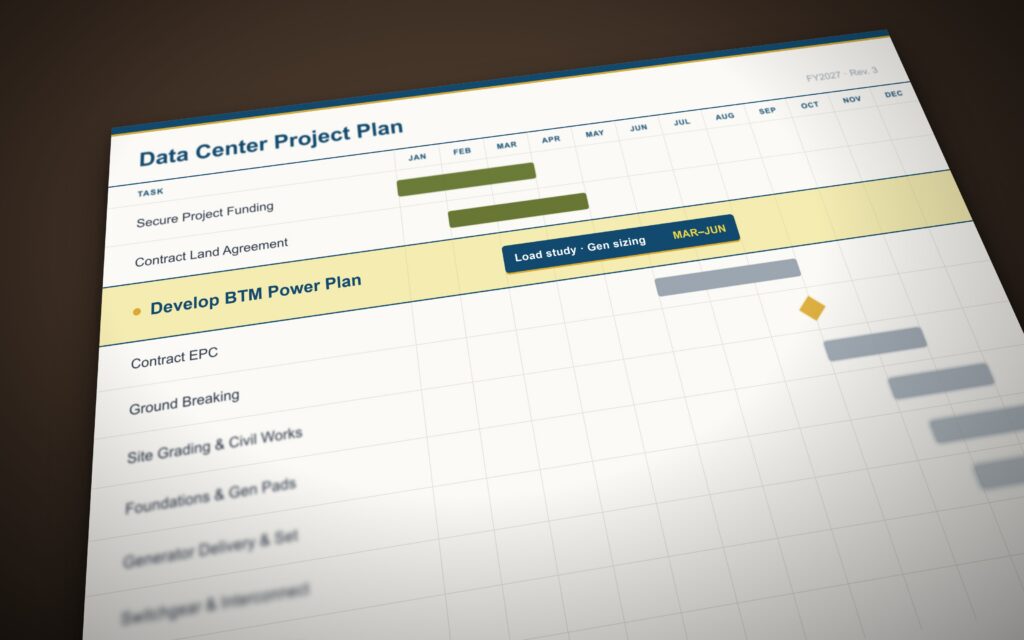
Because the answer changes the design. If there is any chance the plant will run in parallel with the grid or export power later, it needs specific protection systems. Those are far cheaper to design and install at the greenfield stage than to retrofit after the data center is live. The utility may take three, four or five years to arrive. Plan for that day now.
What has to be understood before the plant is designed?
More than megawatts. Air permits determine how much generation a parcel can hold under EPA and state rules, and there are no shortcuts. Putting wheels on a generator and calling it mobile will not get you around federal regulations. We also need to know the site: terrain, soil composition and compaction, and in northern states, the frost line. These plants are heavy.
Why does the data center’s load profile matter so much?
A load that runs steady and one that swings several times an hour call for different technology, and the second may need battery storage to smooth it out. Data centers can also drop large blocks of load in an instant. On an island plant, the generators have to absorb that load rejection. On the grid, the utility does. In July 2026, a transmission line fault in Northern Virginia caused data centers to disconnect and start their backup generators. PJM lost roughly 3 to 4 gigawatts of load at once and saw large swings in voltage and frequency. ERCOT is an island grid, and a similar event here would be hard to absorb. Workloads and chipsets will also change over a 15- to 20-year plant life. The design has to allow for that.
Can the plant do more than make electricity?
Yes, if we ask early. Some of the Caterpillar models we use can supply very hot water through a closed, treated loop. Paired with absorption chillers, that heat can help cool the facility. Ideas like this only fit if they are on the table during design, which is why we want to be in the conversation from the start.
Atlas Solutions
Atlas Energy: We Build Hard Things
In the energy industry, ambition matters. Execution matters more.
Distributed Power
What is an Energy Supply Agreement (ESA)?
For decades, access to power was largely taken for granted. Utilities planned for steady growth, generation capacity kept pace with demand, and electricity was…
Distributed Power
What is Powered Land, and What Value Does it Bring?
Open land is plentiful across the United States, especially in the Midwest and Southwest. But raw land value is a fraction of the potential…