The Data Center Debate Is Running on Old Numbers
How data centers can be built responsibly.
Executive Summary: One of the most highly discussed topics today is Data Centers. Residents arguing for or against local development, policy makers trying to balance growth with land protection, developers hunting for power for their next campus and off-takers who need that power to be reliably delivered, fast. An entire sub-industry of engineers, technologists and academics study grids, water and air for a living are trying to solve for a rapidly expanding demand.
But are the conversations using the most current and accurate information? In many cases, no.
Few people discussing data centers today are neutral. To some, a data center means jobs, tax base and a stake in the AI economy. To others, it’s a thirsty, noisy neighbor that will raise their power bill. Lately, the skeptics have been winning. Heatmap Pro counted about 25 projects canceled after local opposition in 2025, and at least 20 more in the first three months of 2026 alone.
The concerns are legitimate. Most often they come from honest places: excessive water consumption, rising electricity bills, landscape degradation, increased emissions, noise…the list goes on. But increasingly the narrative against data center development includes outdated and misleading information…whether intentionally so or simply uninformed. It often cites decades-old designs and technology, which don’t reflect what’s possible with the data centers being built today. When outdated information drive new decisions, nobody wins…including the communities often desperately needing the recurring revenue stream these projects can bring.

Concern #1: Water Consumption
Water sinks more projects than any other issue, and it’s where old numbers do the most damage. Many figures in circulation come from facilities that cool by evaporating water, which in a hot climate can add up to billions of gallons a year.
AI changed the engineering. The newest GPU racks draw more than 120 kilowatts apiece, far more heat than air can carry, so they’re cooled by liquid in a sealed loop. Outdoor dry coolers shed that heat much like a car radiator, without evaporating anything. Add an on-site power plant cooled by its own closed-loop radiators, and a 250-megawatt AI campus can get by on roughly 1.5 million gallons a year, power plant included. That’s about what a cul-de-sac uses.

Concern #2: Increased Residential Electricity Bills
The next worry is the power bill, and it’s a fair one. The simple fact is our United States electrical grid is maxed out. It does not possess either the generating capacity nor the transmission and distribution infrastructure to meet projected demand.
When a big new load joins the grid, someone pays for the new infrastructure: new lines, substations and other necessary equipment…plus labor. That development cost often lands on every ratepayer amortized over time.
But there’s a new way that won’t affect residential rates: private, self-powered facilities. Generating power is built on site, not on the grid. These “behind the meter” solutions change the math in a hurry. A dedicated plant next to the campus adds no load to the local utility and needs no new high-voltage corridor or eminent domain. It can be more reliable, too. In 2024, a stormy year, the average U.S. customer went about 11 hours without power. A fleet of dozens of engines backed by batteries can be built to 99.99% availability, which works out to under an hour a year.
Concern #3: Air Quality
An early approach to self-powering data centers…even as backup to the grid…was the use of a fleet of diesel generators. Their combustion efficiency and emissions profile is, in fact, undesirable.
A modern designed private power system doesn’t need diesel. Highly efficient, cleaner burning natural gas generators…with high-capacity batteries for backup and restart…combined with catalysts on every gas engine cut nitrogen oxides by 80 to 95% and carbon monoxide by 80 to 90%.
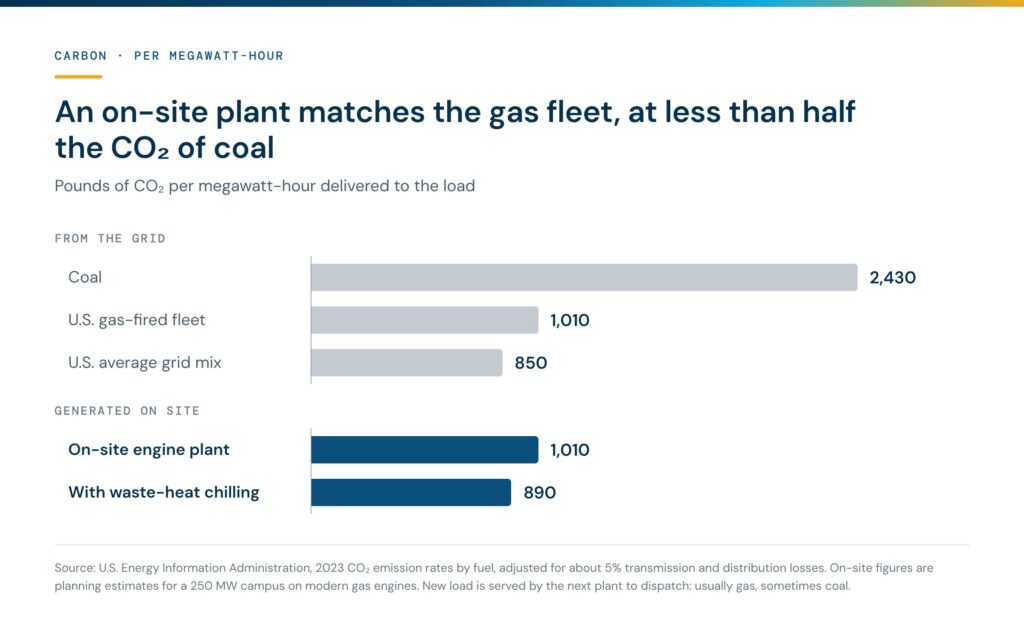
Carbon deserves a straight answer. A gas plant isn’t no-carbon, and it won’t meet the high-bar set by activists seeking a zero carbon solution. But the grid average is the wrong yardstick for new demand, because new load is met by whichever plant dispatches next, usually gas and sometimes coal. And U.S. coal retirements in 2025 were the fewest in 15 years. Measured that way, a well-run on-site plant matches gas and emits less than half as much as coal. Put its exhaust heat to work running the chillers, and it gets close to the grid average.
Concern #4: Noise
Noise rarely makes the top headlines, but it’s certainly a reasonable concern for anyone living in earshot of a facility…especially at 2 a.m. Any power plant…grid or behind the meter…can be noisy up close, and the low-frequency hum is what triggers complaints that drag on for years.
Often times, due to the cost of grid infrastructure, facilities are sited and built closest to dense populations, where infrastructure already exists. That makes economic sense to leverage what already exists. But as many communities have seen, as growth narrows the gap between residential and commercial facilities or utilities, risks of noise pollution increase.
Instead, with behind the meter power, the facility can literally be placed anywhere. Its biggest dependency is gas supply, and some nominal water source…nothing like what old school data centers demand.
The fix is planning: a noise budget set before the site plan is drawn, the powerhouse placed away from homes, heavy walls and tuned silencers where distance isn’t enough, and fence-line monitors with public data. Done right, a plant can hold nighttime levels at the nearest home to the level of a friendly conversation…about 45 decibels.
How We Move Forward, Responsibly
None of this depends on unproven technology. The pieces exist today, and most of them already make economic sense. So, my advice to councils and commissioners is simple: don’t get caught up in unsubstantiated hysteria. Ask questions and look at the real numbers:
- How much water will the whole campus use, power plant included?
- Will it draw on our utility?
- What controls are on every engine, and is there a diesel fleet?
- What’s the noise limit at the nearest home?
- Will you publish the data once you’re running?
A developer who answers those five questions with specifics has earned a fair hearing. One who can’t should expect a tough one. Either way, we’ll all be better off arguing over today’s numbers instead of yesterday’s.
Atlas Solutions
Atlas Energy: We Build Hard Things
In the energy industry, ambition matters. Execution matters more.
Distributed Power
Why On-Site Power Planning Should Start Before a Data Center Breaks Ground?
Bridge power, behind-the-meter generation and island power all promise speed to compute. We asked Atlas experts why the decisions that matter most are made…
Distributed Power
What is an Energy Supply Agreement (ESA)?
For decades, access to power was largely taken for granted. Utilities planned for steady growth, generation capacity kept pace with demand, and electricity was…